The swatch sorter: pick a colour and the shoe cards reorder around it
All fifty-eight shoe cards in one list. Choose a chip or open the colour box, and the list re-sorts so the cards whose photos come nearest to that shade sit at the top, each tagged with how near it is.
Choose a shade for the sorter
Chips give a quick start; the colour box accepts any shade, including one copied from a photo of something you already own.
No colour chosen yet, so the cards below are in shelf order: trainers, boots, heels and flats, then slides and slippers.
 Quilted winter trainers on a lug sole
 Knit runners in a sixteen-shade grid
 Court shoes in pink and in white with blue swirls
 White leather low-tops with a coloured side mark
 Knit runners in pastel and sand tones
 Thick-soled canvas low-tops in bold colours
 Ribbed knit runners with a sculpted sole
 Two-tone low-tops in black, orange, blue and red
 Glossy black high-tops with side zips
 All-white and all-black leather low-tops
 Wavy-panelled runners in olive and charcoal
 Low-tops in a mixed colour grid
 High-top trainers with a padded ankle
 Thin-upper racing runners in bright colourways
 Puffy skate trainers with fat laces
 Scuffed-finish white leather trainers
 Runners with a cushion window, thirty pairings
 Retro runners in neon and pastel pairings
 Plain court shoes with a contrast side stripe
 Suede low-tops on gum soles
 Ripple-line runners in silver, gold and black
 Padded skate trainers in snakeskin print and black
 Black leather slip-on trainers
 Lug-sole lace-up boots in sage, black and tan
 Suede mini boots with a side button
 Mini boots in beige, orange and black
 Chestnut sheepskin mini boot
 Mini boots and platform slippers in one grid
 Chestnut suede Chelsea and lace-up boots
 Children's fleece-collar boots with a strap
 Children's leather-look mini boots in tan and brown
 Rubber-toed mini boots in orange, black and taupe
 Quilted children's snow boots in navy, red and grey
 Classic suede mini boots in four plain shades
 Bow-back fluffy boots in a stack of bright colours
 Patent zip boots with a shearling cuff
 Platform suede slip-ons with a fluffy collar
 Lug-sole chestnut mini boot
 Split-toe ballet flats in black, tan and silver
 Red patent strappy sandals on a stiletto
 Pale pink satin Mary Janes with a slim heel
 Black satin pointed pumps with a jewelled heel
 White pointed slingbacks with a low heel
 Black leather slingback pumps
 White satin pointed flats with an oversized bow
 Denim-print pointed slingbacks with a buckle
 Black patent ankle-strap sandals with a sculpted heel
 One-piece foam slides in a twenty-shade grid
 Padded embossed slides in black and cream
 Black leather slides with a metal buckle
 Printed and fur-topped slides on a display shelf
 Cut-out foam clogs in neutral and red shades
 Foam slides and cut-out clogs on their boxes
 Black foam slide on its shoebox
 White padded-strap sandals on a platform sole
 Fleece-lined slip-on booties in chestnut, black and sand
 Shearling-lined Mary Jane slip-ons with a platform
 Platform clogs in candy colours
Working the sorter by hand
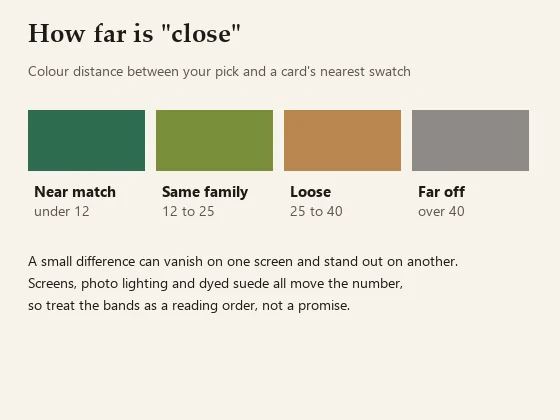
This is how to use this tool: press a chip. The list below it re-sorts at once, and each card shows the one measured swatch that came closest to your pick, with a label saying how close: near match, same family, loose or far off. The first ten or so cards are usually the useful ones; after that you are looking at shoes that merely share a corner of the photo with your colour.
To try a shade the chips do not cover, use the colour box. On most devices it opens a picker with an eyedropper or a hex field. A hex code from a product photo or a paint chart works well; the sorter reads it the same way it read the shoe photos.
The sorter remembers your last colour in the page address, so a link copied after sorting opens the same order for someone else. Nothing is stored anywhere else, and no card is hidden; the sorter only changes the order.
How each card's colours were measured
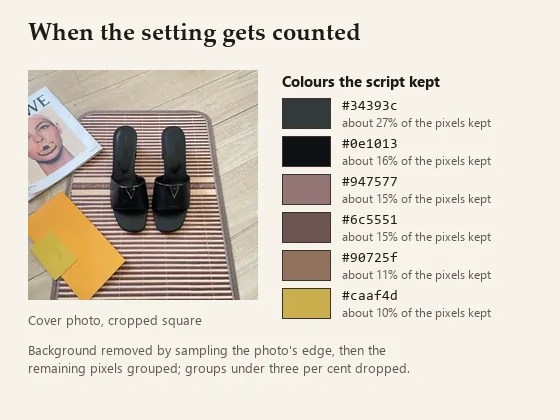
Each cover photo was cropped square and shrunk to ninety-six pixels across. A script then sampled the colours along the photo's outer edge and treated anything close to them as background, which removes the white or grey backdrop on most product shots.
The remaining pixels were grouped into up to eight clusters by colour, measured in a colour space designed to match how people see differences. Clusters smaller than three per cent of what was left were dropped, near-identical ones were merged, and up to six were kept. Those are the swatches under each card, largest first.
When you pick a colour, the sorter works out the distance from your pick to every swatch on every card and ranks each card by its closest swatch. A card with one tiny red swatch can therefore rank high for red; the label tells you it matched, and the photo tells you how much of the shoe is actually red.
Where a measured colour misleads
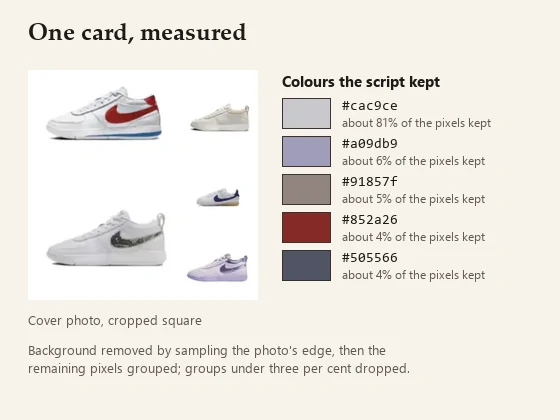
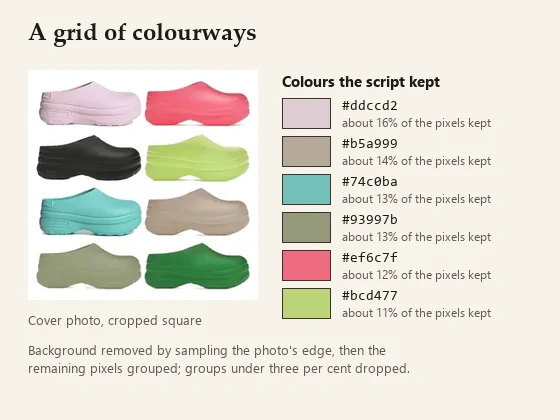
Measuring a whole photo has honest limits, and most of them show up on the trainer shelf. A grid cover with sixteen colourways produces swatches for the four or five commonest colours in the grid and drops the rare ones. A lime pair that appears once in a grid of greys may not register at all.
Shadows and highlights are the next problem. White leather in shadow measures as pale grey, and patent leather reflects the room. The script has no idea which pixels are shoe and which are shadow, so a white trainer often carries a grey swatch as large as its white one.
Finally, the photo colour is not the shoe colour. Camera settings, warehouse lamps and screen differences all move it. Use the sorter to shorten the list, then judge the shortlisted listings by their own photos and option names.
When the photo setting gets counted
Background removal only works when the edge of the photo is a plain backdrop. Many sellers shoot on boxes, mats, sofas and shop shelves, and those surfaces reach the edge of the frame in uneven patches that the script cannot separate from the shoe.
The leather slides on this card were photographed on a striped mat beside a magazine; their swatches include the mat's browns and a yellow from the magazine as well as the black of the slides. Boots held up in front of red shoeboxes pick up red the same way.
Rather than hide those cards, the sorter keeps them and the descriptions say when the setting is busy. If a card ranks oddly high for a colour that is not on the shoe, look at what else is in the photo.
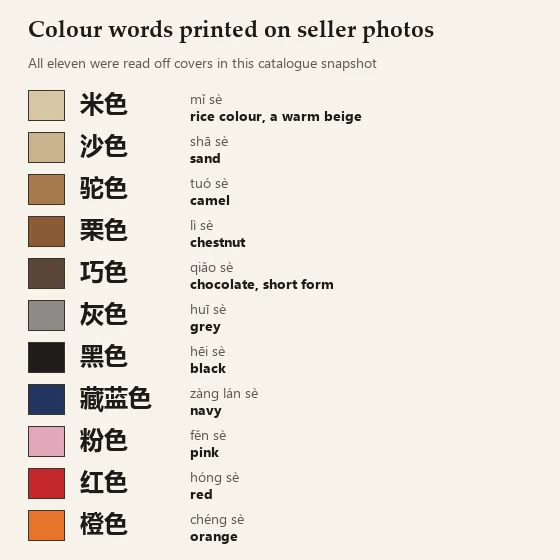
Chinese colour words seen on these covers
Sellers often print colour names straight onto their photos, so the buyer can match each photo to an option. Eleven different words appear on the covers in this snapshot. Most end in 色, which simply means colour.
- 米色 (mǐ sè), literally rice colour: a warm beige or off-white.
- 沙色 (shā sè), sand: pale grey-beige, lighter than camel.
- 驼色 (tuó sè), camel: the classic mid-brown of camel hair.
- 栗色 (lì sè), chestnut: a warm red-brown, the commonest suede colour on the boot shelf.
- 巧色 (qiǎo sè), short for chocolate: a dark cool brown.
- 灰色 (huī sè) grey, 黑色 (hēi sè) black, 粉色 (fěn sè) pink, 红色 (hóng sè) red, 橙色 (chéng sè) orange.
- 藏蓝色 (zàng lán sè), navy: a deep blue, sometimes close to black on screen.
Labels are not a guarantee. On one boot cover the photo labelled 黑色 shows a boot closer to dark navy than black; the label is the seller's name for the option, and the warehouse photo is what tells you what arrived.