
Trainers on the Lace Bench, from chalk white to signal orange
The trainer shelf holds twenty-three cards, each priced as the catalogue showed it on 20 October 2026. Most covers show several colourways at once, which is why the measured swatches under each card often run to five or six colours.
Low, mid and high cuts in a trainer listing
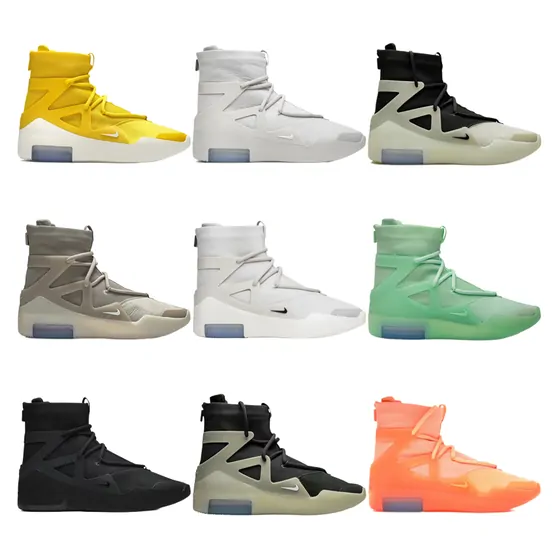
A trainer listing rarely states its cut in words you can search for. The title, often half English and half Chinese, tends to give a model nickname; the cut is something you read off the photo. Low-tops finish below the ankle bone, mids cover it, and high-tops climb past it with a padded collar, like the nine pairs on the cover to the right.
Chinese titles sometimes help: 低帮 means low-cut, 中帮 mid-cut, 高帮 high-cut. When a listing mixes several cuts in one photo grid, the option list on the product page usually separates them, and that option is the line to copy into your order note.
High-tops are the cut most often bought for looks and returned for fit. The collar presses on the ankle in a way a low-top never does, and a size that works in a runner can feel tight around the top. If you are between sizes and buying a high-top, the larger one is usually the safer guess.
One listing, a whole wall of colourways
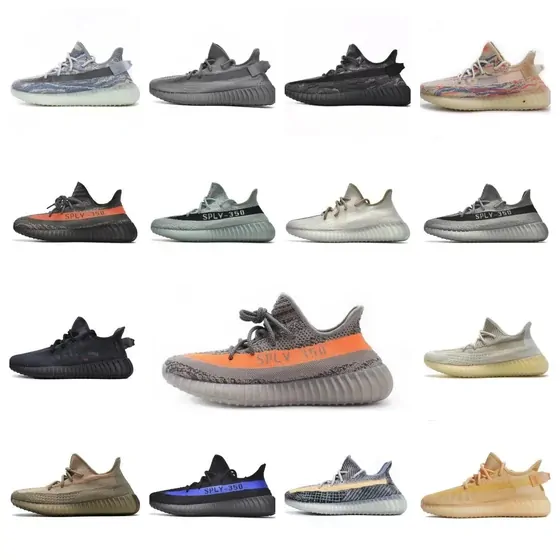
Seventeen of the twenty-three trainer covers on this shelf are grids showing four or more colour versions in one photo, and two of them squeeze in thirty. Sellers do this to save space, and it is useful for browsing, but it hides one practical problem. The photo is not the item you will receive; it is a menu.
On the product page each colourway is an option with its own name, sometimes descriptive (white grey, 白灰), sometimes a code, sometimes a number that matches the position in the grid. Before you order, find the option whose name matches the pair you want and check whether the option has its own photo. If it does, that photo is a better guide than the grid.
This is also why the swatch sorter can rank a grid card near several different chips. The script measures every colour it finds on the cover, so a grid of sixteen knit runners carries grey, oat, brown and orange swatches at once. The card is a near match for all of them, and the option list decides which one you actually get.
Soles and toe boxes the cover photo skips
A cover is almost always a side view. That shows the colour and the silhouette, but not the two things that most decide comfort: the shape of the toe box seen from above, and the sole seen from below. Listings usually have more photos than the cover; scroll the gallery on the product page for a top-down shot and an outsole shot.
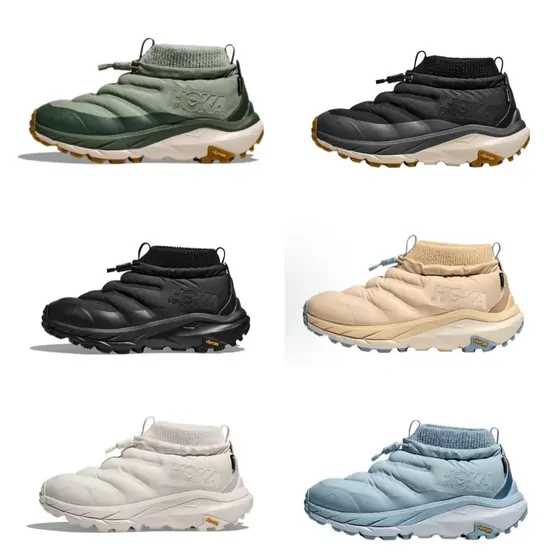
Chunky soles like the lug-edged winter trainers here look heavy in the photo and usually are. A heavy sole changes how a pair travels as well as how it walks: shoes are often the heaviest single item in a parcel, and agents charge shipping by weight or by box size.
For a toe box, look for a photo taken from the front at shoe height. A narrow, pointed front in that photo is a fair warning for wide feet, whatever the listing says.
Trainer sizes and the note you send with them
Most trainer listings sell by European-style numbers, 36 to 45 or so, and many add a foot-length chart as one of the gallery photos. That chart is the useful part. Stand barefoot on plain paper, pencil a mark at your heel and at your longest toe, measure between the marks, find the length on the seller's chart, and order the size it points to rather than converting from a size on a shoe at home.
Write the size and the colour option into the order note in plain words, exactly as they appear on the listing. Agents buy what the order says; a note that reads "size 42, white grey option, as per photo 3" is much harder to get wrong than a bare number.
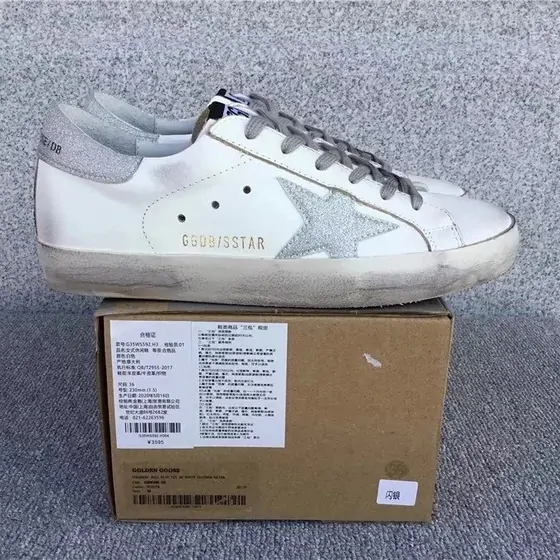
The cover to the right shows a pair standing on its carton, with a label on the box end. Warehouse photos often include that label, and it is the quickest way to confirm the size that actually arrived before anything is posted.
Trainer cards measured for colour
Every card links to its catalogue listing. Prices are as read on 20 October 2026; the swatches are the colours measured on the cover, largest share first.
 Quilted winter trainers on a lug sole
Padded uppers in six shades from forest green to ice blue, each set on a chunky sole with a tan edge.
 Knit runners in a sixteen-shade grid
Sock-like knit with a striped side panel; greys and earth tones dominate, with one orange-striped pair.
 Court shoes in pink and in white with blue swirls
Two colour options shown large: a soft all-pink pair and a white pair wrapped in blue and black lines.
 White leather low-tops with a coloured side mark
Plain white uppers where only the side mark changes: red, beige, navy or lilac.
 Knit runners in pastel and sand tones
Fourteen soft shades including blush, sage, oat and a single bright lime pair near the bottom.
 Thick-soled canvas low-tops in bold colours
Fat white soles under canvas in black, tomato red, hot pink, mustard, bottle green and slate.
 Ribbed knit runners with a sculpted sole
Rippled knit uppers over a moulded sole; the grid runs from pale grey through olive to rust and black.
 Two-tone low-tops in black, orange, blue and red
Overlaid leather panels on a white base, four colour pairings in one listing.
 Glossy black high-tops with side zips
One pair photographed on a shop counter, black leather with metal zips running up the outside.
 All-white and all-black leather low-tops
The cheapest card on this shelf at the time of reading: one tonal white pair and one tonal black pair.
 Wavy-panelled runners in olive and charcoal
Layered side panels in three dark options, the olive one with a small yellow accent.
 Low-tops in a mixed colour grid
Sixteen variations on one shape, from neon green and orange to printed purple uppers.
 High-top trainers with a padded ankle
Tall, smooth uppers in yellow, white, stone, mint, orange and black, all with the same chunky sole.
 Thin-upper racing runners in bright colourways
Light mesh uppers on thick foam, shown in teal, orange, sage, blue and a speckled multicolour pair.
 Puffy skate trainers with fat laces
Padded leather in cobalt, cream with rope laces, pink, burgundy and mustard.
 Scuffed-finish white leather trainers
A single pair standing on its shipping carton, the white leather deliberately worn at the toe.
 Runners with a cushion window, thirty pairings
A dense grid of the same runner in white, black, red, navy, khaki and pastel mixes.
 Retro runners in neon and pastel pairings
Another crowded grid, with more pink, lime and sky blue than the plain white versions.
 Plain court shoes with a contrast side stripe
Smooth white leather with a black, pink or white stripe; one pair is black with a white stripe.
 Suede low-tops on gum soles
Low, flat shoes in white, cream, black and a brick red, most standing on caramel rubber.
 Ripple-line runners in silver, gold and black
Metallic finishes take up most of the photo: silver, gold, gunmetal, white and one pale pink pair.
 Padded skate trainers in snakeskin print and black
Chunky laced trainers, two in a grey snake pattern, one black and one dark camouflage green.
 Black leather slip-on trainers
Laceless black uppers with a wide strap across the instep and a white lining.